

How to Build a Spending Plan You Will Not Quit by February
Most people do not blow their budget on one big purchase. They blow it on forty small ones they never wrote down. The car payment shows up on the statement, predictable as Monday. The fun stuff sneaks in five and ten dollars at a time, and by month’s end the math does not add up. This piece walks through a spending plan you can actually keep: where to look first, how to split the money, and the one small habit that stops the whole thing from quietly falling apart.
Why Most Budgets Break Before Spring
A budget that does not survive month two is not a budget. It is a wish you wrote down in January.
Three things usually kill it. The categories are too vague, so “fun” becomes a black hole nobody can explain. The numbers are too optimistic, set on a calm Sunday by a version of you who forgot that birthdays, car repairs, and bad weeks exist. And there is no review point, so the first overspend feels like total failure instead of a normal Tuesday. The New York Times often highlights how these small tracking failures derail even the best intentions.
Notice that none of those problems are about discipline. They are about design. A plan built on willpower asks you to be your best self every single day, which is a losing bet for anyone who has ever met a human being. A plan built on clear lines and a quick weekly check asks far less of you, and that is exactly why it lasts. To better understand how our psychology affects these choices, you can listen to the podcast with Daniel Crosby on overcoming financial biases.

Where Does Your Money Actually Go?
Before you cap anything, you have to see it. Most people can name their rent and their car payment in a heartbeat, then go fuzzy on everything else. That fuzzy part is where the leaks live, so it deserves a real list.
Here are the discretionary categories that tend to absorb the most cash without anyone noticing:
- Eating out and food delivery
- Streaming services and digital subscriptions
- Hobbies with recurring costs, from gym add-ons to gear upgrades
- Concerts, sports, and weekend trips
- Online gaming and casino sessions
- Gifts and social spending, like rounds of drinks and group dinners
- One-off splurges, the “for fun” gadget or course
The order of size differs from one household to the next. Yours might be dinners out; your neighbour’s might be subscriptions they forgot they had. The only way to know is to track one ordinary week and add it up. People are routinely surprised, and the surprise is the point.
Where Online Entertainment Fits in the Line Item
Online entertainment is the easiest part of the budget to underestimate. There is no physical receipt, no waiter clearing the table, no parking meter to remind you that real money is moving.
Subscriptions renew quietly. In-app purchases are one tap. A gaming session that was meant to last forty minutes can drift into two hours without any obvious signal to stop.
The fix is not willpower. The fix is to push the limit out of your head and into the tool itself. Pre-set caps work because they make “stop now” the default, not the decision you have to make at the wrong moment.
If your entertainment line includes online gaming, NV Casino gives you deposit caps and session reminders that keep the monthly number predictable. The cap is set once, on a calm afternoon, and it does the policing for you the rest of the month. That trick beats any willpower trick I have tried, and it works for streaming spend too once you set the same limits inside the app store.
We tested the NV deposit-cap tool against a manual sticky-note system over a single month, and the gap was not close. The Casino account knew the rule. The sticky note did not.
The 50/30/20 Split and Where It Bends
A clean starting frame is the 50/30/20 split: roughly half of take-home pay to needs, thirty percent to wants, twenty percent to savings and debt. It is popular because it is simple, and simple plans get followed.
It bends, though, depending on your life. High rent in a big city eats into the needs half fast. A serious savings goal, like a down payment, can push the savings slice higher and squeeze the wants. Treat the percentages as a conversation starter, not a rulebook handed down from on high. On a macro level, governments face similar structural pressures; as discussed by The Economist, chasing the wealthy rarely fixes a fundamentally broken broader budget.
The useful move is to name the split you are actually using, then check it against where the money went last month. If reality and the plan disagree by a wide margin, the plan loses. Adjust the numbers to fit your life rather than pretending your life will fit the numbers.
How Much Should You Spend on Fun Each Month?
Here is the question that trips people up. They either set the fun number so low it breaks within weeks, or they leave it undefined and let it eat the savings line. A working answer for most Canadian households sits between three and seven percent of monthly take-home pay, with savings health as the anchor. For those looking for practical retirement and savings advice tailored for regular Canadians, the podcast with Robb Engen offers great insight into managing these allocations.
| Monthly take-home (CAD) | Lean cap (3%) | Comfortable cap (5%) | Upper cap (7%) |
| C$3,000 | C$90 | C$150 | C$210 |
| C$4,500 | C$135 | C$225 | C$315 |
| C$6,000 | C$180 | C$300 | C$420 |
| C$8,000 | C$240 | C$400 | C$560 |
These are starting points, not gospel. A hard weekly sub-cap inside the monthly number tends to work better than one big monthly figure, because a single large total quietly invites a single large weekend. Splitting C$300 into roughly C$75 a week keeps the pace honest and gives you four small checkpoints instead of one anxious reckoning at the end. These personal choices are also heavily influenced by the broader economic climate, which is detailed in the podcast with Benjamin Tal on the state of Canada’s economy and housing market in 2026.
The Habit That Locks It In
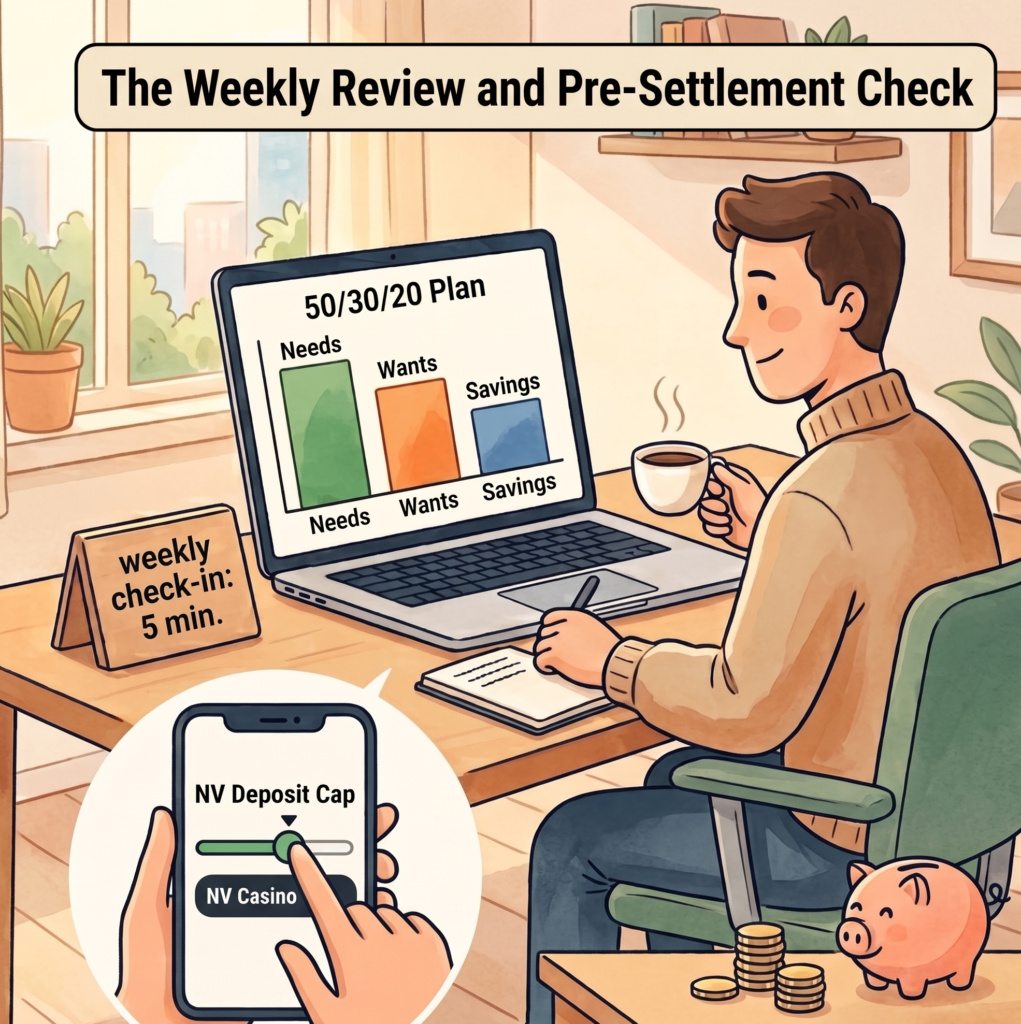
The plan is not the hard part. The five-minute weekly check is.
Once a week, sit down with a coffee and look at three things: what you spent, what is left, and whether any category is running hot. That is it. One quiet review beats one panicked statement-scroll on the thirtieth every time. Name your sub-lines, pick a starting split you can defend, set a recurring reminder, and let the habit do the work your willpower was never built to do.

 The Fully Updated "The Wealthy Barber" Is Available Now!